June 29, 2026
What Is Happening While We Talk?
I recently went on a work date with a friend. It was one of those lovely Bangalore days with the perfect weather. We had our laptops out, were bouncing ideas off each other, and sipping on our favourite cups of coffee.
And then, as is tradition in Bangalore, the weather decided to have other plans.
I found myself drenched while waiting at a traffic signal, and lo and behold, my laptop (which I hold dearer than my own life) had suffered water damage. The problem? A new screen. The treatment? Expensive. The side effects? A rather large hole in my pocket and a healthy dose of guilt.
But at least there was a solution. A clear, straightforward, albeit expensive solution. Replace the screen, and my laptop (along with my life's work) would be just fine.
And somewhere between the repair bill and the relief of knowing that my laptop could be fixed, it struck me: if only fixing things in life were this simple. If only in therapy we could replace the broken bits, pay the bill (preferably a smaller one), and walk away knowing everything would be just fine.
To most people, therapy looks like two people (a client and a therapist) sitting in a room and talking, with the expectation that somewhere in the middle of all that talking, healing happens.
And to be fair, from the outside, that’s pretty much what it looks like. Two people having a conversation. No fancy equipment, no visible repairs, no dramatic transformations. Just talking.
It’s easy to see why therapy can seem deceptively simple, and why some people might be sceptical about it.
How can a conversation do something that's so intangible?
Maybe this is why many people in therapy wonder whether it’s actually working. I've even had clients tell me, "Can we skip today? I have nothing to talk about." The instinct is to treat therapy like a trip to the emergency room - If I’m not actively bleeding, why am I here? And yet, some of the most meaningful changes I have witnessed in therapy have emerged from conversations that, on the surface, appeared as though nothing much was happening.
Part of the reason for this is that therapy is not only useful during moments of crisis. When we are struggling, therapy often focuses on survival. We are trying to get through the week, manage overwhelming emotions, navigate difficult decisions, and cope with immediate stressors. When we're in the middle of a crisis, it's a bit like trying to understand the architecture of the room while the fire alarm is going off. Our attention is understandably focused on what feels urgent.
But when the crisis subsides, something else comes into view: the beliefs and behaviours that were relentlessly shaped and reinforced through years of lived experience. The stories we carry that quietly influence our choices, the fears we rarely pause long enough to acknowledge, and the ways- both helpful and limiting- that we have learned to protect ourselves.
This is one reason I often encourage clients to attend sessions even when life feels relatively uneventful. The absence of a crisis does not mean the absence of meaningful work. In fact, it often creates the space for a different kind of work to emerge.
Which raises an important question: if therapy is not simply about solving immediate problems, what exactly is happening while we sit and talk?
One answer is that therapy often provides something many people have had surprisingly little of in their lives: a different experience.
One of the things that has become increasingly clear to me as a therapist is that people do not heal simply because they understand themselves better. Understanding matters, but meaningful change often requires something more. It requires new experiences.
Many people arrive in therapy carrying assumptions about themselves, other people, and relationships that were shaped long before they entered the room. Over time, they may have learned that expressing emotions leads to criticism, that asking for help leads to disappointment, or that vulnerability is unsafe. These beliefs rarely feel like beliefs. They feel like facts because they have been reinforced through experience.
And because these beliefs were often learned through experience, they are rarely changed through insight alone. Knowing something intellectually is not always enough to transform how we feel, respond, or relate to others. Change often requires an experience that challenges our existing beliefs. Our minds and bodies need a real, visceral encounter with evidence that contradicts those beliefs before lasting change can occur.
This is one reason why therapy can be more powerful than it appears from the outside. Many people come into therapy expecting the same responses they have received elsewhere: dismissal, judgment, criticism, indifference, or being told they are overreacting. Instead, they encounter something different.
You speak about an experience you have spent years questioning and find that someone takes it seriously. You share an emotion you have learned to hide and you are met with curiosity rather than criticism. You talk about something painful and you are given space to stay with it rather than rush past it.
This has the power to completely flip our inner script.
This is also why reading about psychology, watching videos, listening to podcasts, or following therapy content online can only take us so far. These resources can offer insight, language, and understanding - it feels good to “finally get it.” But insight alone rarely creates change.
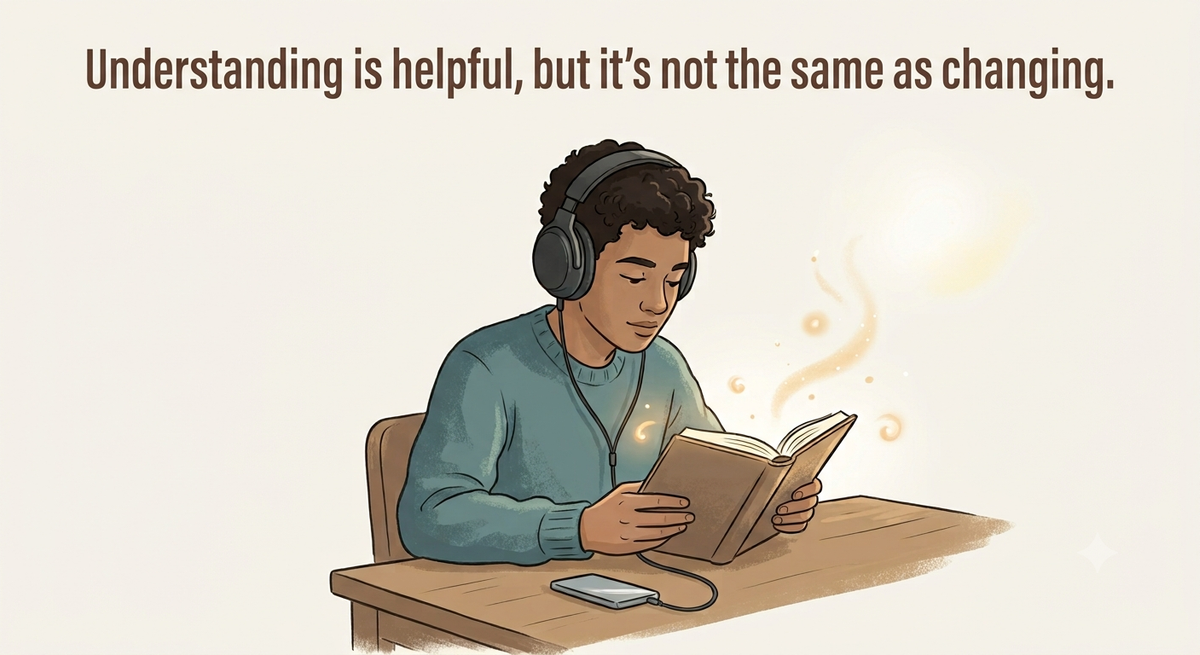
Sometimes change begins not because we learn something new about ourselves, but because we experience something different.
And as we are going through these experiences, we are also learning a very significant skill - we are building the capacity to stay with difficult emotions without becoming overwhelmed by them.
In many ways, change is not only about feeling understood. It is also about gradually becoming more able to tolerate experiences that once felt unbearable.
I often think of each of us as carrying an internal emotional container. It holds everything we experience- emotions, thoughts, memories, urges, physical sensations, etc. The size of that container influences how much we can hold before feeling overwhelmed. When it feels too full, even relatively small experiences can feel unbearable.
This capacity varies from person to person. It is shaped by our life experiences and by the ways our nervous systems have adapted over time. When someone’s emotional container is already quite full, or small in size- perhaps because they’ve always lived in a highly unstable environment, or they’re navigating an abusive relationship, carrying overwhelming caregiving responsibilities, or planning a wedding- even relatively small stressors, such as a delayed message or minor criticism at work, can feel devastating.
What feels manageable for one person may feel completely overwhelming for another. The same disappointment, conflict, or setback can be processed with relative ease by one individual, while flooding someone else with intense emotions.
A significant part of therapy involves helping people gradually expand that container. This is one reason therapists often encourage people to “sit with” their emotions rather than immediately trying to escape them (yes, this includes making a self-deprecating joke in the middle of a crying session to cut the tension). We are wired to run away from negative emotions - they feel like a disease we need to cure. And despite how frustrating it can sometimes feel, it is also why we return to difficult experiences in therapy instead of quickly moving past them.
When you talk about a painful conversation with a family member, you are not simply recounting an event. You are practicing staying with the emotions that arise alongside it. For the fitness enthusiasts out here- think of it as progressive weightlifting. When a therapist asks another question after you have started crying, the goal is usually not to make you feel worse. It is to help you remain with an experience that you may have spent years avoiding, suppressing, or moving away from. Like your spotter at the gym, we are helping you lean into the discomfort, to do the hard thing. We are helping you learn that you can move through it, that nothing catastrophic happens if you confront your sadness, grief, or rage, for example. And this helps expand the walls of the container, you’re "building the muscle” for it. The weight still stays the same, but you’re able to lift it without it destroying you.
The goal is not to eliminate difficult emotions. Sadness, uncertainty, conflict, and grief will continue to show up throughout our lives. What often changes is our ability to make room for them without being overwhelmed by them.
And that kind of change is difficult to capture in a worksheet, strategy, or coping skill.
This is one reason why therapy is not simply about learning tools. Tools matter. Boundaries matter. Communication skills matter. Techniques can be incredibly helpful. But therapy is often working on something deeper than what a strategy or worksheet can reach. The “5 tools to work with your relationship anxiety” checklist can only take you so far.
I've worked with many clients who worried that a session wasn't productive because they didn't leave with a concrete action plan. Others felt disappointed because they didn't feel better by the end of the hour. Yet some of the most important sessions I've witnessed would probably look unproductive from the outside.
Sometimes a session is spent sitting with grief that has been avoided for years. Sometimes it's spent acknowledging a truth that has become increasingly difficult to ignore. And yes, sometimes that means you spend most of the session crying.
There are moments in therapy when the work is not about fixing, solving, or changing anything. The work is allowing ourselves to be with what is already there.
This is not always comfortable. In fact, it is one reason people sometimes leave therapy feeling worse than when they arrived.
"Many assume that if therapy is helping, they should experience immediate relief. But therapy often draws attention to things that have been living in the background for years."
Every time we listen, every question we ask, every observation we offer, every moment of challenge or validation is usually serving a purpose, even if that purpose is not immediately obvious. The conversation is not just a part of the work, it is the work.